
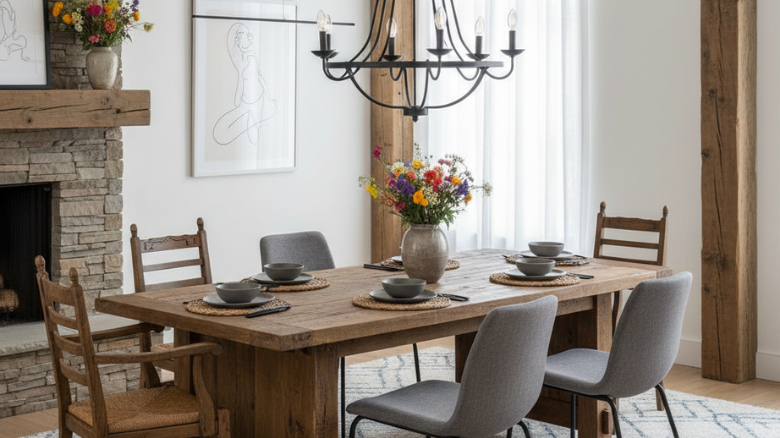
The dining table is the centrepiece of a home's social life. It is where daily meals become rituals, where celebrations take shape, and where conversations linger long after the plates are cleared. Choosing a dining table is choosing the backdrop for those moments — which is why style matters as much as specification. Here is a tour of the major dining table styles to help you identify where your taste and your home intersect.
Rustic and Farmhouse
Characterised by chunky turned or straight-square legs, distressed or naturally oiled solid wood surfaces, and a deliberate celebration of grain, knots, and natural imperfection, the rustic farmhouse table is built on the idea that furniture should look as though it has always been there. These tables suit open-plan kitchen-dining spaces, homes with exposed brick or stone walls, and interiors that lean into natural textures across the board. The most enduring examples are made from reclaimed or sustainably sourced sheesham, mango, or acacia wood, where the patina of the material itself is the design. A trestle base — two A-frame or X-frame end supports connected by a central stretcher — is the classic structural choice for this style, offering stability alongside a sense of honest, honest making.
Industrial
Industrial dining tables combine solid wood tops — often thick-cut planks of oak or pine — with powder-coated steel or cast-iron bases. The contrast of warm grain against matte black or gunmetal metal is the defining visual tension of the style. Industrial tables work exceptionally well in loft apartments, converted spaces with high ceilings and large windows, and modern interiors that deliberately reference utility and craft. They are typically very robust, which makes them an excellent choice for households with children, as the metal base eliminates any concern about leg instability under rough treatment.
Scandinavian and Contemporary
Defined by clean lines, tapered legs, restrained use of material, and a commitment to functional elegance, the Scandinavian dining table is one of the most enduringly popular styles in residential interiors. Tables in this style favour lighter woods — ash, birch, beech, and pale oak — finished with clear lacquer or natural oils that protect without obscuring the wood's character. The legs are typically slender and angled slightly outward, giving the table a sense of lightness and precision. These tables blend effortlessly into contemporary, transitional, and even mid-century interiors and are among the most versatile in any collection.
Mid-century Modern
The mid-century dining table is distinguished by a strong graphic quality: bold tapering legs in solid walnut or teak, clean rectangular or oval tops, and a restraint that borders on architectural. These tables pair naturally with upholstered dining chairs in warm jewel tones and brass or copper hardware details. The oval top, in particular, is a hallmark of the mid-century aesthetic and has the practical advantage of eliminating corner seats, which both improves comfort and creates a more convivial arrangement for conversation.
Modern Minimal and Monochrome
For interiors built on a palette of white, grey, and black with deliberate material contrast, the modern minimal dining table is the natural choice. These tables favour sintered stone, marble, glass, and lacquered wood tops on simple geometric bases — square or rectangular tops with straight aprons, monolithic pedestal bases in stone or concrete-look composite, or architectural trestle bases in brushed steel. They are uncluttered by ornament and rely entirely on proportion and material quality to communicate value. A stone top on a brushed steel base, for instance, does all its visual work in the interplay of texture, weight, and surface.
At Anu Furniture, every dining table style in our collection has been chosen because it does justice to the room it enters — and to the meals, conversations, and celebrations that will unfold around it for years to come.